 Gridbinder
Guide · Planning the book
How many puzzles per book, and how to mix the levels
The number of puzzles sets the page count, the page count sets the printing cost, and the printing cost sets the lowest price you can charge. Plan the three together.
Updated 29 October 2026 · Examples are real, unedited pages from the Gridbinder studio unless the caption says otherwise.
What the count does to the page count
Here are real page counts from books made in our studio, including the title page, how-to pages, answer key and Verification report:
| Book | Pages | Printing cost on Amazon.com |
|---|---|---|
| 150 Sudoku, 6 x 9 in, two per page | 109 (KDP counts 110) | $2.30 (fixed cost up to 110 pages) |
| 100 Sudoku, 8.5 x 11 in, one per page | 118 | $3.01 (large trim: $1.00 + 118 x $0.017) |
| 100 Sudoku, 8.5 x 11 in, large print | 132 | $3.24 |
| 100 word search, 8.5 x 11 in, one per page | 128 | $3.18 |
Notice the jump at 110 pages: a black ink book of 24 to 110 pages pays only the fixed printing cost on Amazon.com. A 150-puzzle 6 x 9 in Sudoku book with two per page fits under that line; the same puzzles one per page would not. Use the calculator to check any combination.
Choosing the number
- Gift and beginner books: 100 to 150 puzzles is plenty. A reader who finishes a book and wants more is a reader for volume 2.
- Regular solvers: 200 to 300 puzzles of one level give value per dollar, and these readers compare counts.
- Large print: fewer puzzles, one per page, at a price that does not punish the extra pages.
- Mixed logic books: 10 to 30 of each type, so every type gets enough practice to be learnt.
Mixing the levels
A progressive book starts easy and gets harder, so a beginner learns as they go and finishes with a sense of progress. A single-level book suits people who already know what they like, and most of them say so in reviews when the level is wrong.
Whatever you choose, define the levels. "Hard" should mean something you can describe, for example "needs a what-if step" or "larger grid with backward words", and the book should say it on the how-to page.
Sections every puzzle book needs
- Title page and copyright page.
- How to solve, for every puzzle type in the book.
- The puzzles, numbered, with type and level under each title.
- Solutions, numbered the same way.
- Optional: a few lined notes pages, a page that tells readers how the puzzles were checked, a list of other books.
How Gridbinder handles levels and counts
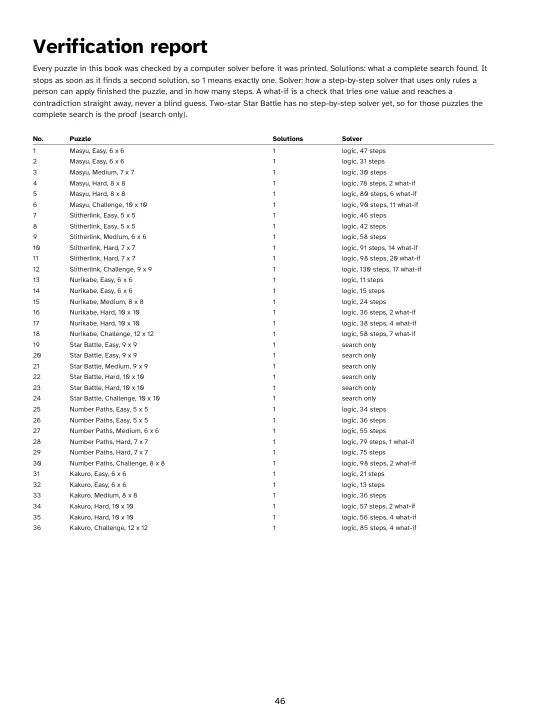
You choose 1 to 300 puzzles and a level: Easy, Medium, Hard, Challenge or Progressive. Easy and Medium puzzles are finished by direct deductions; Hard and Challenge may also need a one-step what-if check, never a blind guess. The Verification report at the back of each book lists every puzzle with its level, size, the number of solutions a complete search found and, for every type with a step-by-step solver, how the solver finished it. (Two-star Star Battle is proved by the complete search only, and the report says so.) Killer Sudoku stops at Hard and Star Battle has Medium and Hard only; the studio tells you when it uses the nearest level.
Questions
How many puzzles are in a typical Sudoku book?
Usually between 100 and 300. Large print books tend to have fewer, one per page.
Does adding puzzles always make the book better value?
Not always. More pages raise the printing cost and so the lowest price you can charge. Readers of gift and beginner books rarely need more than 150.
What is a progressive puzzle book?
A book whose puzzles start easy and get harder from front to back, so the reader learns as they go.
Sources
- KDP: Paperback printing cost, checked 29 October 2026
- KDPEasy: Puzzle book FAQ (how many puzzles, difficulty levels), checked 29 October 2026
KDP changes its rules from time to time. If a number here and the KDP help page disagree, the KDP page wins; please tell us at support@arling.sk.