 Gridbinder
Guide · Planning the book
Answer keys and unique solutions in puzzle books
The answer key is where a puzzle book earns or loses trust. If a reader's correct grid does not match your solution, they do not blame the puzzle; they blame the book.
Updated 29 October 2026 · Examples are real, unedited pages from the Gridbinder studio unless the caption says otherwise.
Why exactly one solution matters
A Sudoku with two valid solutions lets a reader finish a correct grid that differs from the answer key. The same happens with a Slitherlink loop that can go two ways, or a Nonogram with two pictures that fit the clues. The reader did nothing wrong, and the book looks broken.
Uniqueness is a property you can prove: a complete search tries every possibility and finds either one solution or more than one. Many free generators and old puzzle packs do not tell you whether they ran such a search.
Unique is not the same as fair
A puzzle can have exactly one solution and still need a blind guess to reach it. Solvers dislike that, because the puzzle stops being logical. The second check is a step-by-step solver that uses only rules a person can apply. If that solver finishes the puzzle, a reader can too.
Harder levels may need deeper reasoning, such as trying one value and following the forced moves until they contradict. That is still logic, because the contradiction proves the value wrong. Guessing and hoping is not.
Laying out the answer key
- Put solutions at the back, in the same order as the puzzles, with the same numbers and type labels.
- Use small grids, several to a page, but not so small that digits blur. Bold numbers help.
- For word search, mark each found word clearly; grey out the filler letters.
- For loop and path puzzles (Slitherlink, Masyu, Number Paths), draw the solution line thick enough to follow.
- Start the solutions on a new page with a clear heading, so readers can find them without seeing other answers.
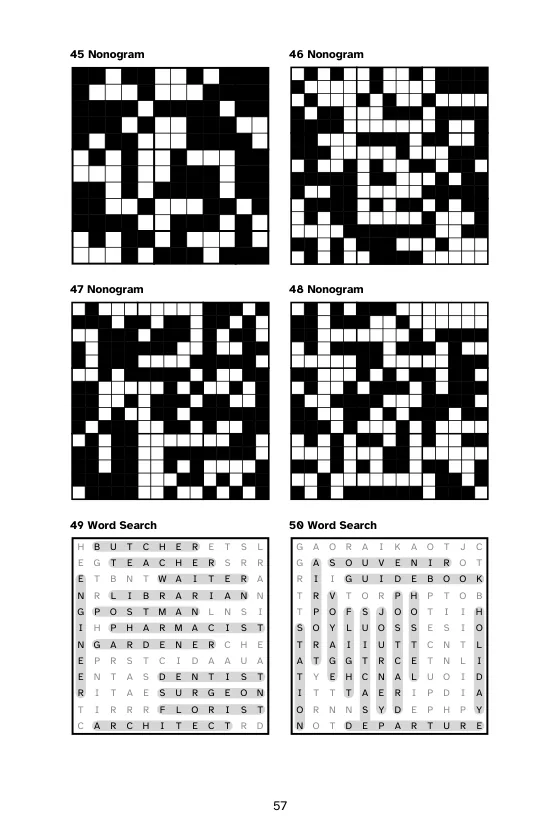
A page that shows how the puzzles were checked
Some publishers add a short note on how the puzzles were made. Gridbinder goes further with a Verification report: a table at the back listing every puzzle with its level and size, the number of solutions a complete search found, and how the step-by-step solver finished it. It is on by default and can be switched off. A reader who doubts a puzzle can see that it was checked, and so can a reviewer.
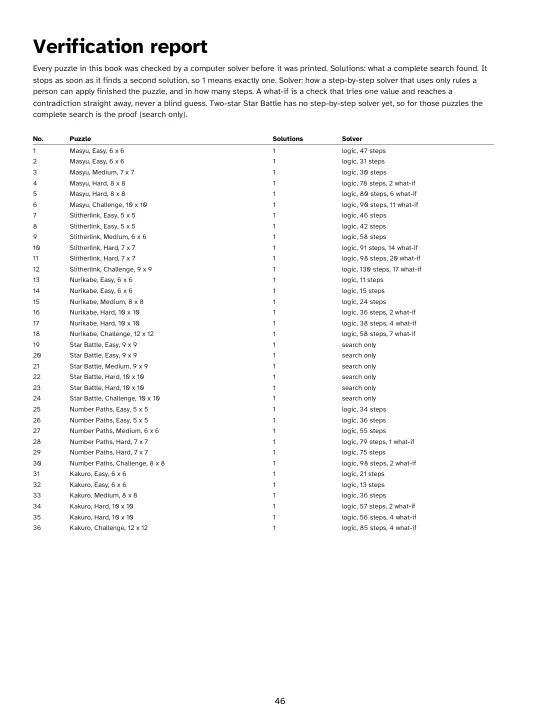
How to test puzzles you did not make
- Solve five puzzles from each level yourself, without looking at the answers.
- Compare with the answer key. Any mismatch where your grid is also valid means a second solution.
- Note where you had to guess. If an Easy puzzle needed a guess, the levels are not reliable.
- Ask the seller or tool how uniqueness and levels are checked, in writing.
In Gridbinder
Every puzzle is searched completely for a second solution and thrown away if one exists. Every type except two-star Star Battle must also be finished by a step-by-step solver that uses only rules a person can apply; two-star Star Battle is proved by the complete search only, and the report says so. The answer key and the Verification report are built from the same data as the puzzles. See it in the free sample.
Questions
Can a Sudoku have more than one solution?
A grid can, if too few numbers are given or they are badly placed. A proper Sudoku has exactly one, and a complete search can prove it.
Where should the answer key go?
At the back, in the same order as the puzzles, with the same numbers. Start it on a new page.
What is a Verification report?
Gridbinder's table at the back of a book that lists each puzzle with its level, size, the number of solutions found by a complete search, and how the step-by-step solver finished it.
Sources
- Sudoku Challenges: Can a Sudoku have multiple solutions?, checked 29 October 2026
- KDP: Content guidelines (disappointing content), checked 29 October 2026
KDP changes its rules from time to time. If a number here and the KDP help page disagree, the KDP page wins; please tell us at support@arling.sk.