 Gridbinder
Guide · Planning the book
How to make a Sudoku book for KDP, step by step
Sudoku is one of the most common puzzle book types on Amazon, which means readers know exactly what a good one looks like. These are the steps from idea to upload, with the decisions that make the difference.
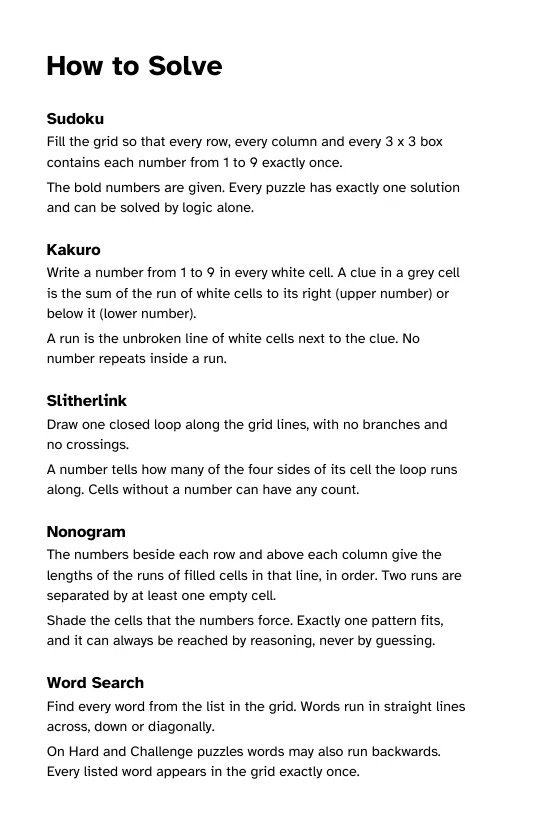
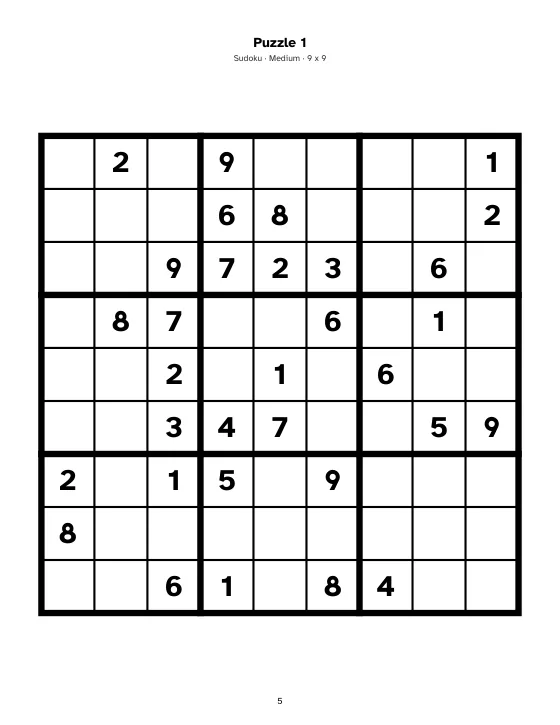
Updated 29 October 2026 · Examples are real, unedited pages from the Gridbinder studio unless the caption says otherwise.
1. Choose the reader
"Sudoku book" is too broad to stand out. Pick one reader and write it down: a beginner who needs Easy puzzles and a clear how-to page, an older solver who needs large print, a commuter who wants a small book, or a regular solver who wants Hard puzzles and nothing else. Every other decision follows from this one.
2. Choose trim size and layout
8.5 x 11 in with one puzzle per page gives the biggest grid and suits large print. 6 x 9 in with one puzzle per page is a comfortable size for regular solvers; two per page works for Easy and Medium if readers do not use pencil marks. See trim size and paper for the trade offs and printing costs.
3. Choose how many puzzles and which levels
Common counts are 100 to 300 puzzles. More is not always better: a 300-puzzle book on a large trim costs more to print, which pushes up the list price. A progressive book (Easy to Challenge) suits gifts and beginners; a single-level book suits solvers who know what they want. See how many puzzles.
One KDP tool blog (linked below) calls mislabelled difficulty the most common complaint about Sudoku books: a "Hard" book that felt easy, or an "Easy" book that needed guessing. Use levels that are defined by the logic a puzzle needs, not only by how many numbers are given.
4. Make sure every puzzle is sound
A Sudoku must have exactly one solution. If it has two, a reader can finish a correct grid that does not match your answer key. It should also be solvable by logic, without guessing. A puzzle generator should check both, by searching for a second solution and by solving the puzzle step by step the way a person would. Ask any tool you use how it does this. See answer keys and unique solutions.
5. Lay out the interior
- Title page and copyright page.
- A how-to page: the rules in plain words, and an example if you have room.
- The puzzles, each with a number and level label.
- The answer key, in the same order, with the same numbers.
- Margins from KDP's table for your final page count, fonts embedded, nothing under 7 pt. See the PDF checklist.
6. Make the cover from the page count
With the final interior PDF, you know the page count and so the spine width. Use the spine and cover calculator and KDP's cover template. Show a real inside page on the back cover or in your listing images; buyers want to see the grid size.
7. Publish and describe it honestly
On KDP, a puzzle book is not a low-content book (KDP lists puzzle books as "not generally low-content"), and you can get a free KDP ISBN. In the description say how many puzzles, which levels, the trim size, whether there is one puzzle per page and that solutions are included. Do not promise brain health benefits. See are puzzle books low content?
KDP allows up to 2 new titles per format each week, so a series is a project of several weeks. Plan the next volumes with new puzzles, not the same ones in a new cover.
Doing it in Gridbinder
In the studio, pick Sudoku (or Killer or Anti-Knight Sudoku), the trim size, one or two per page, the level and the number of puzzles, up to 300. The studio builds the title page, copyright page, how-to page, puzzles, answer key and a Verification report into one PDF, and shows the page count for the cover. Every puzzle is checked for a second solution and solved step by step before it goes in. The free sample has 12 puzzles with a watermark and needs no account.
Questions
How many Sudoku puzzles should a KDP book have?
Most Sudoku books have between 100 and 300. Choose the number that fits the reader and the list price; a large trim with many pages costs more to print.
Do I need an ISBN for a Sudoku book?
Puzzle books are not low-content books by KDP's definition, so a paperback needs an ISBN. KDP gives you a free one, or you can use your own.
Should a Sudoku book have an answer key?
Yes. Readers expect solutions at the back, numbered like the puzzles.
Can I use Sudoku puzzles from a free website?
Only if its terms allow commercial use, and even then other publishers may use the same puzzles. KDP treats content that is freely available on the web as disappointing content. See the guide on puzzle generators and duplicate content.
Sources
- KDP: Low-content books (puzzle books are not generally low-content), checked 29 October 2026
- KDP: Create a book (2 new titles per format per week), checked 29 October 2026
- KDP: Guide to Kindle content quality, checked 29 October 2026
- KDPEasy: How to create Sudoku puzzle books for KDP (difficulty labels as the top complaint), checked 29 October 2026
KDP changes its rules from time to time. If a number here and the KDP help page disagree, the KDP page wins; please tell us at support@arling.sk.