 Gridbinder
Guide · Planning the book
Logic puzzle books beyond Sudoku
Sudoku shelves are crowded. Kakuro, Nonogram, Slitherlink, Masyu and the rest have devoted solvers and far fewer books. Here is what each type asks of the reader and of the layout.
Updated 29 October 2026 · Examples are real, unedited pages from the Gridbinder studio unless the caption says otherwise.
Eleven types at a glance
| Type | What the reader does | Grid, easiest to hardest | Good for |
|---|---|---|---|
| Killer Sudoku | Sudoku with cage sums, no given digits | 6 x 6, 9 x 9 | Sudoku fans who want arithmetic |
| Anti-Knight Sudoku | Sudoku where equal digits may not be a knight's move apart | 6 x 6, 9 x 9 | Experienced Sudoku solvers |
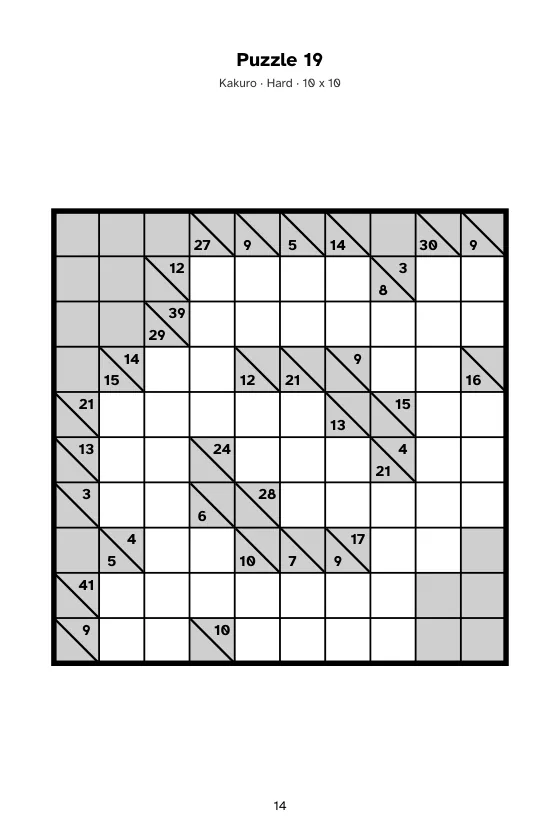
| Kakuro | Fill runs with digits that add to the clue, no repeats | 6 x 6 to 12 x 12 | Number lovers, crossword fans |
| Nonogram | Shade cells from row and column clues to reveal a pattern | 8 x 8 to 15 x 15 | Visual solvers |
| Slitherlink | Draw one loop; numbers say how many sides of a cell it uses | 5 x 5 to 9 x 9 | Patient line drawers |
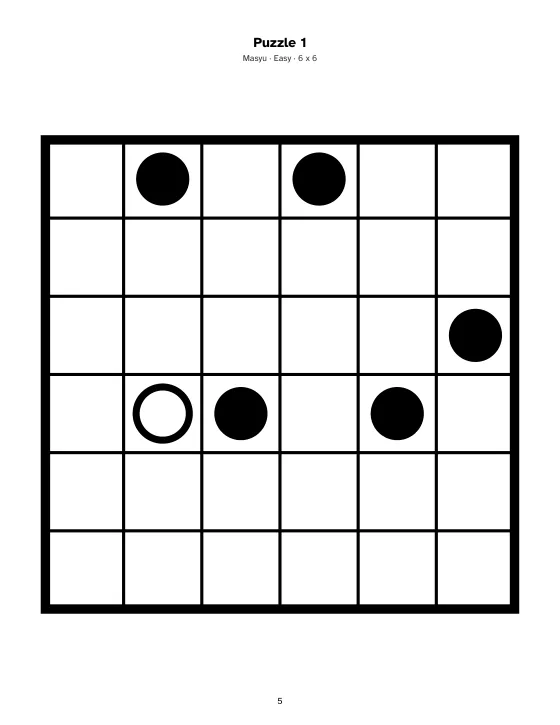
| Masyu | Draw one loop through all circles, with turn rules | 6 x 6 to 10 x 10 | Readers who like elegant rules |
| Nurikabe | Shade a wall around numbered islands | 6 x 6 to 12 x 12 | Fans of area puzzles |
| Star Battle | Place stars in every row, column and region, never touching | 9 x 9, 10 x 10 | Quick, tense puzzles |
| Bridges | Connect islands with the number of bridges shown | 7 x 7 to 13 x 13 | Gentle logic, all ages |
| Number Paths | Connect matching numbers with paths that never cross | 5 x 5 to 8 x 8 | Beginners and children |
| Sudoku | Digits 1 to 9 in every row, column and box | 9 x 9 | Everyone |
Choosing types for a book
- A single-type book is easiest to describe and to search for: "Kakuro puzzle book, 150 puzzles".
- A mixed book of three to five types suits gift buyers and solvers who get bored. Keep 10 to 30 of each, so readers can learn a type before it changes.
- Pair a known type with a new one. Sudoku plus Killer Sudoku, or Word Search plus Bridges, makes the new type less of a risk.
- Mind the names. Some puzzle names are trademarks in some countries. See copyright and trademarks.
Layout notes by type
Nonograms need space above and to the left of the grid for clue numbers, so a 15 x 15 Nonogram wants a full page. Kakuro and Killer Sudoku have small clue numbers in the corners of cells; check that they stay at 7 pt or more at your trim size. Loop puzzles need dots or cells that are clearly visible but light, so the reader's line stands out.
How-to pages are part of the product
A reader who has never seen a Masyu needs the rules in three or four short sentences, ideally with a small solved example. Put the how-to pages at the front and repeat the one-line rule as a reminder in the section heading. Unclear rules lead straight to "too hard, could not start" reviews.
Proof matters even more here
Readers rarely know how to check a Slitherlink or a Nurikabe for a second solution themselves. A puzzle that has two answers, or needs a guess, makes them give up on the type for good. That is why every logic puzzle in Gridbinder is searched for a second solution and, for every type except two-star Star Battle, finished by a step-by-step solver before it goes in a book. See answer keys and unique solutions.
Questions
Which logic puzzle is easiest for beginners?
Number Paths and Bridges have very simple rules and small grids at the easy level. Nonograms are also easy to learn because the result is a picture.
How do I format a Kakuro book?
One puzzle per page on 6 x 9 in for larger grids, two per page only for small ones; keep clue numbers at 7 pt or more, and include a how-to page with the rule that digits in a run never repeat.
Are mixed logic puzzle books a good idea?
They suit gift buyers and curious solvers. Keep enough puzzles of each type for readers to learn it, and label every puzzle with its type.
Sources
- KDPEasy: Puzzle book FAQ (formatting Kakuro and KenKen), checked 29 October 2026
- KDP: Fonts (minimum 7 pt), checked 29 October 2026
KDP changes its rules from time to time. If a number here and the KDP help page disagree, the KDP page wins; please tell us at support@arling.sk.